Perimenopause is the transition leading up to the final period, and it commonly begins in the mid-forties. Symptoms starting before 45, and particularly before 40, still warrant medical assessment rather than assumption. The first sign is almost never a hot flush. It is a change in the cycle: periods arriving closer together, then further apart, and often heavier before they become lighter. Menopause itself is a single point, twelve consecutive months without a period and not using hormonal contraception, so everything before that point is perimenopause and it can run for several years. At my clinic in Belgravia, treatment during this transition runs alongside conventional care rather than instead of it, and is reviewed at about three months.
The most common thing I hear from women in their early forties is that somebody has told them they are too young.
Too young for this to be hormonal. Too young to be asking about the perimenopause. Sometimes the person saying it is a clinician, sometimes it is a friend, and often it is the woman herself, dismissing the idea before anyone else gets the chance.
The premise is wrong. Perimenopause is not a thing that begins at 51. Fifty-one is roughly when periods stop in the UK. The transition leading up to that point routinely begins in the mid-forties and can begin earlier, which means a woman of 43 with a cycle that has changed shape, sleep that has become fragile, and a temper she does not recognise is not too young. She is on time.
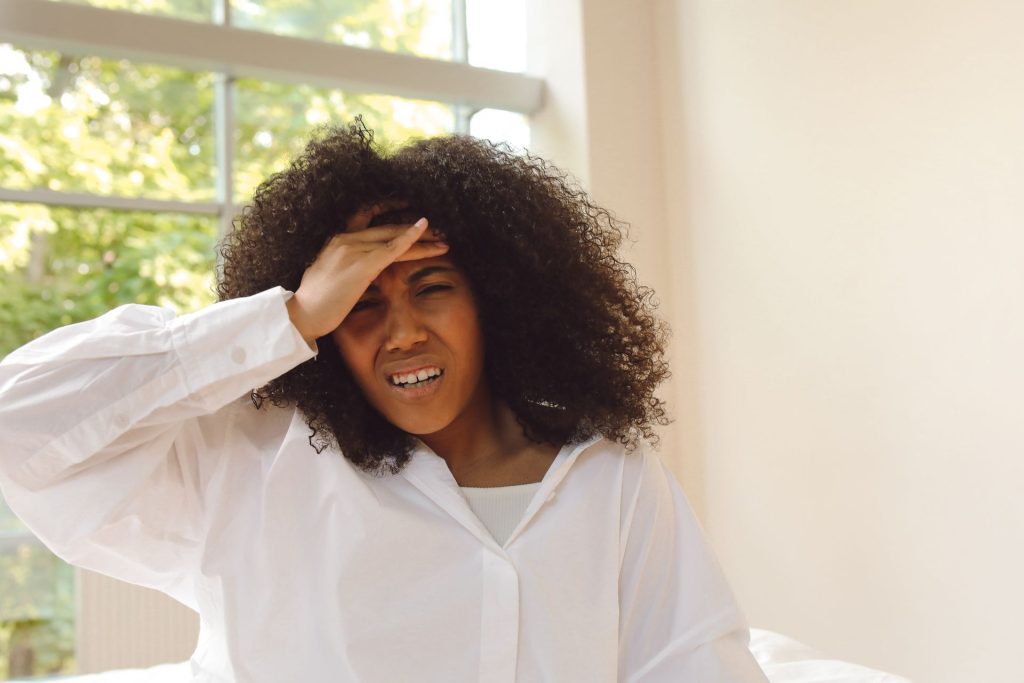
Perimenopause Starts With the Cycle, Not the Hot Flush
This is the single most useful correction on this page, because it is the reason so many women miss the start of it.
Hot flushes and night sweats are the symptoms everyone knows, and they usually arrive later in the transition rather than at the beginning. What arrives first is a change in the pattern of the cycle. Typically that means cycles shortening at first, so periods come closer together than they used to, followed later by cycles lengthening and becoming unpredictable, with skipped months. Flow often becomes heavier before it becomes lighter, which surprises women who were expecting a gradual fade.
If your cycle has changed shape in your forties and nothing else has changed, that is worth taking seriously rather than filing under stress. The timing side of this is covered in more detail in acupuncture and Chinese medicine for irregular periods.
The Symptoms That Do Not Get Named
Beyond cycle change, hot flushes, and night sweats, the transition produces a set of symptoms that are rarely connected to it, and that is where most of the distress sits. Women arrive believing they have developed anxiety, or a memory problem, or a joint condition, having never been told these belong to the same picture.
- Sleep that breaks at three in the morning, commonly the first symptom noticed after the cycle itself changes, and frequently mistaken for stress alone
- Anxiety or low mood with no obvious trigger, sometimes in women with no previous mental health history
- Word-finding difficulty and short-term memory lapses, commonly described as brain fog
- Muscle aches and joint pains, often blamed on age or exercise
- Rage or irritability out of proportion to the situation, which is one of the most distressing symptoms and among the least discussed
- Palpitations, which are common in the transition and should still be mentioned to a GP
- Recurrent urinary symptoms and vaginal dryness, which unlike most symptoms here tend to worsen rather than settle after menopause
- Worse symptoms after drinking, with alcohol recognised as a common trigger for hot flushes
None of these is proof of anything on its own. Taken together, in a woman in her forties with a changing cycle, they form a recognisable picture.
What Most Women Get Wrong About Perimenopause
They expect a blood test to confirm it. In the UK, perimenopause in women over 45 is generally diagnosed on symptoms and cycle change rather than on a hormone test, because hormone levels fluctuate so much during the transition that a single reading tells you little. A test taken on a good week can look entirely normal. That does not mean nothing is happening. Testing has a clearer role under 45, and particularly under 40, where premature ovarian insufficiency needs to be excluded.
They think it is a two-year event. NHS guidance puts the usual span of symptoms at seven to nine years, and sometimes longer. Planning around it as though it were a brief phase is why so many women are caught out.
They stop contraception too early. Fertility falls during the transition but does not disappear when cycles become irregular, and it does not disappear the moment periods stop. NHS guidance is that contraception is still needed for one year after your final period if you are 50 or over, and for two years after your final period if you are aged 40 to 49. It is also worth knowing that HRT is not a contraceptive, so if you are taking it and still need contraception, that is a separate conversation with your GP.
They see HRT and Chinese medicine as a choice between two camps. They are not competing options, and framing them that way costs women time. Hormone replacement is a decision for you and your GP based on your symptoms, history, and risk profile. Chinese medicine is used alongside it for the symptoms it does not fully settle, or by women who cannot take it or have chosen not to.
How Traditional Chinese Medicine Reads the Transition
In classical Chinese medicine the menopausal transition is described as a natural decline in Kidney essence, the reserve that governs reproductive function across a lifetime. That decline is expected rather than pathological, which shapes the whole approach: the aim is not to reverse the transition but to reduce the turbulence of it.
Three patterns account for most presentations, and they explain why women experience this so differently from one another.
TCM pattern | How it presents | Other signs | Classical formula family |
|---|---|---|---|
Kidney Yin deficiency | Hot flushes, night sweats, dry skin and eyes, thirst, waking in the small hours | Cycles shortening, feeling hot in the afternoon and evening, restlessness | Formulas that nourish Yin and clear deficiency heat, selected to the case |
Kidney Yang deficiency | Feeling cold rather than hot, fatigue, low back ache, night waking to pass urine | Cycles lengthening, low mood, fluid retention, reduced libido | Formulas that warm and support Kidney Yang, selected to the case |
Liver Qi stagnation with Heart disturbance | Irritability, rage, palpitations, disrupted sleep, symptoms clearly worse under pressure | Premenstrual worsening, breast tenderness, tension headaches | Xiao Yao San family, adjusted to the case |
The formulas above are listed for professional reference and to show how the reasoning works. They are not intended for self-medication. Chinese herbs must be prescribed to a diagnosed pattern by a practitioner who has taken your full history and knows what else you are taking.
The clinically useful point is the first two rows. A woman who feels relentlessly hot and a woman who feels cold and exhausted are both perimenopausal, and the two are approached in opposite directions. That is why the formula is matched to the presentation rather than to the diagnosis of perimenopause. This is why a consultation asks about temperature, sleep timing, and energy in some detail rather than working from a symptom checklist.
The third row is the one most often seen in women managing demanding work through the transition, and it is worth naming because rage and palpitations are the symptoms women are most reluctant to raise.
Where Treatment Fits Alongside HRT
To be direct about this, because the SERP is full of pages implying a choice.
Hormone replacement therapy is the most effective treatment available for vasomotor symptoms, and whether it is right for you is a conversation with your GP. Nothing on this page is a reason to avoid that conversation or to stop treatment you are already taking.
Chinese medicine is used in this context in three situations. Alongside HRT, for symptoms that remain once the flushes have settled, most often sleep, mood, and joint aches. In place of it, for women who cannot take it or have chosen not to. And before it, for women in early perimenopause whose symptoms do not yet warrant it but whose cycles and sleep have already changed.
Acupuncture is applied with the aim of easing symptoms, with point selection following the diagnosed pattern. Responses vary between individuals and no outcome is guaranteed. In my clinical experience the formula tends to do more of the work here, with acupuncture supporting it, because the symptoms are daily rather than cyclical and a formula can be taken daily and adjusted as the picture shifts.
Formulas here are personalised rather than taken from a shelf, and prepared as powder, capsules, or tea. The current fixed price is £80 per week, designed for a minimum course of two weeks, with complimentary UK delivery. Acupuncture sessions are £100 for 60 minutes, or £360 for a package of four. Because these symptoms are daily rather than cyclical, the review window is measured in months rather than cycles. Plan to reassess at about three months.
When to See Your GP
Arrange a GP appointment before, or alongside, starting any Chinese medicine treatment if:
- You are under 45, and particularly under 40, with symptoms suggesting the transition, since this needs proper assessment rather than assumption
- You have bleeding between periods, after sex, or any bleeding at all after twelve months without one
- Periods have become very heavy, or are affecting your daily life
- You have palpitations, chest pain, or breathlessness
- Low mood or anxiety is significant, persistent, or affecting how you function
- You want to discuss hormone replacement therapy, which is a medical decision and not one to take on the basis of a website
Chinese medicine works best when the picture has been properly assessed. A practitioner who discourages you from seeing your GP, or who advises you against HRT, is a practitioner to leave.
If you take any medication, including HRT, bring the details to your consultation. Acupuncture does not interact pharmacologically with medication. Herbal formulas can, which is why a complete list is required before anything is prescribed.
Online Consultation Across the UK
The transition is well suited to remote care, because the intervention that carries the work is a formula rather than a hands-on treatment.
An online consultation runs 15 to 30 minutes by video and covers full medical history, detailed symptom analysis, and guided tongue and facial observation, which translate well to video. From that, a formula is prescribed and posted with complimentary UK delivery, then adjusted at follow-up as symptoms change, with a fuller reassessment at about three months.
Bring three things. A list of everything you currently take, including HRT and supplements. A note of your cycle over the last six months, including any skipped months. And a short account of your sleep, specifically what time you wake and whether you get back to sleep, because that detail distinguishes the patterns above more reliably than the flushes do.
It is also worth asking whether the practitioner can prescribe at all. Many clinics offer acupuncture only. I am qualified to prescribe Chinese herbal medicine as well, which for symptoms that occur daily rather than weekly is the difference between treating at appointments and treating throughout.
One further question worth asking any herbal practitioner is where the herbs come from. This clinic dispenses Sun Ten herbal extracts from Taiwan, which are tested for heavy metals and hold GMP, ISO, and TGA certification, and it works only within MHRA-compliant herbal medicine. Herbs bought unregulated online carry no such guarantee, which matters more than usual here, because supplements marketed for menopause are a large and poorly regulated market.
What You Will Receive After Your Consultation
- A personalised clinical report as a PDF. Your assessment, TCM diagnosis, treatment strategy, lifestyle recommendations, and follow-up plan.
- A tailored Chinese herbal medicine plan. A prescription formulated to your diagnosed pattern, revised as symptoms shift through the transition.
- A clear treatment roadmap. What improvement to expect, in what order, and when to reassess.

Frequently Asked Questions
What Are the First Signs of Perimenopause?
The first sign is usually a change in the cycle rather than a hot flush. Periods commonly shorten in interval first, then lengthen and become unpredictable, and flow often becomes heavier before it becomes lighter. Disturbed sleep, particularly waking in the small hours, is frequently the next symptom noticed. Hot flushes and night sweats tend to arrive later in the transition rather than at the start.
At What Age Does Perimenopause Start?
It commonly begins in the mid-forties. NHS guidance describes menopause as usually affecting women between 45 and 55, with the transition running before that, and notes it can happen earlier. Because the average age of the final period in the UK is around 51 and the transition often runs for several years, symptoms in the early forties are entirely consistent with perimenopause rather than being too early for it. Symptoms starting before 45, and particularly before 40, still warrant medical assessment rather than assumption, since premature ovarian insufficiency needs to be excluded.
Can a Blood Test Confirm Perimenopause?
In women over 45, perimenopause in the UK is generally diagnosed from symptoms and cycle change rather than from a hormone test, because levels fluctuate so widely during the transition that a single reading is unreliable. A normal result does not rule it out. Testing has a clearer role under 45 and particularly under 40, and that is a conversation to have with your GP.
What Does Chinese Medicine Recommend for Menopause?
Chinese medicine does not have one recommendation for menopause, because it does not treat menopause as a single condition. It distinguishes between presentations, most commonly Kidney Yin deficiency where the dominant experience is heat, Kidney Yang deficiency where it is cold and fatigue, and Liver Qi stagnation where it is irritability and disturbed sleep. The formula follows the pattern, which is why two women of the same age receive different prescriptions.
Can I Use Chinese Medicine Alongside HRT?
Yes, and for many women that is the sensible arrangement. Hormone replacement is a medical decision made with your GP, and Chinese medicine is commonly used alongside it for symptoms that persist once the flushes have settled, particularly sleep, mood, and joint aches. Any herbal prescription must take account of what you are already taking, so bring the details to the consultation.
How Long Does Perimenopause Last?
It varies considerably. NHS guidance puts the usual span of symptoms at seven to nine years, and sometimes longer. Menopause itself is only recognised in retrospect, so planning for a multi-year process rather than a brief phase tends to be closer to the reality.
What Happens Next
- Book an appointment through the booking page, in person in Belgravia or as an online consultation.
- Attend the consultation, bringing your medication list, six months of cycle dates, and a note of your sleep pattern.
- Receive your personalised clinical report, herbal prescription, and treatment roadmap.
- Reassess at about three months, with the formula adjusted as the transition moves.
Liu’s Chinese Medicine Clinic is a women’s health clinic at 9 Eccleston St, London SW1W 9LX, inside the Light Centre in Belgravia, and treats patients across the UK by video. Clinic hours are Monday to Friday, 9:30 AM to 1:30 PM, with the last appointment at 1:30 PM. If you would rather ask a question before booking, you can message the clinic on WhatsApp.
You may also find these useful: acupuncture and Chinese medicine for irregular periods, acupuncture and Chinese medicine for heavy periods, Chinese herbal medicine at the clinic, and about Practitioner Liu.